

Navigating Tokenization, AI, ESG, and Market Integrity in Thailand’s Capital Market Future
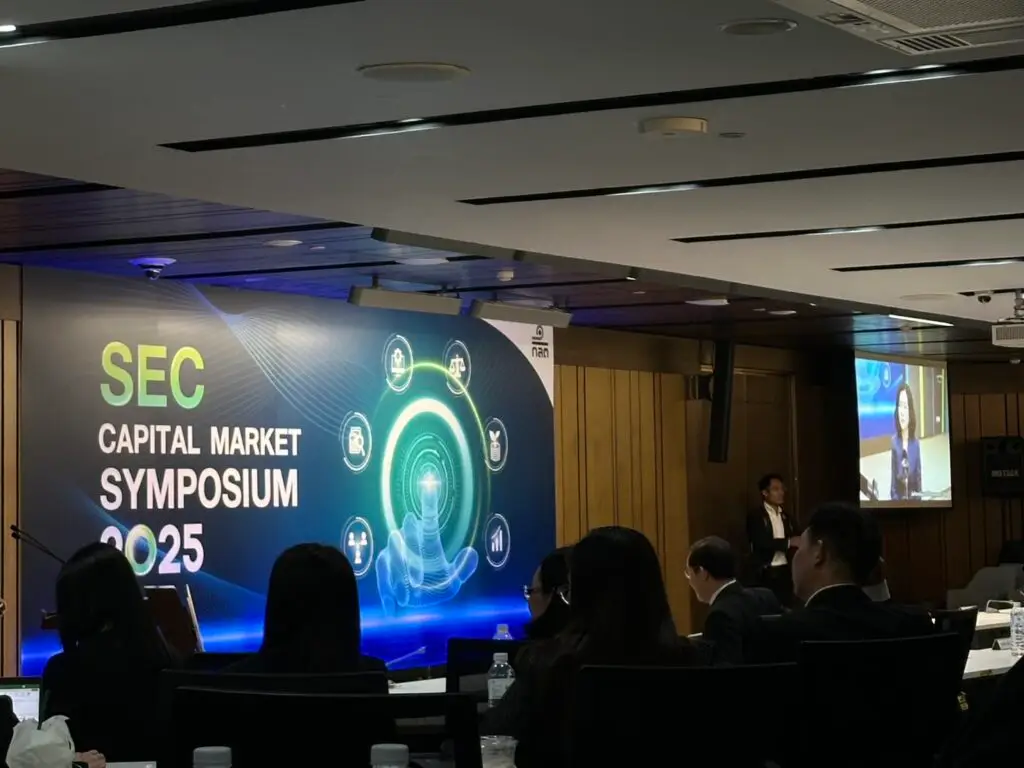
On 12 November 2025, Nibbana, Our Partner of Lex Bangkok, joined regulators, academics, and market leaders at the SEC Capital Market Symposium 2025, hosted at the Securities and Exchange Commission (SEC Thailand) headquarters in Bangkok.
This year’s symposium, themed “Capital Market Innovation and Sustainable Transformation,” explored how emerging technologies, regulatory frameworks, and ESG integration are redefining Thailand’s investment landscape.
As a firm advising clients in digital-asset, fintech, and corporate finance, we at Lex Bangkok view this event as an essential window into how policy and innovation converge to shape the country’s capital-market direction.
1. Tokenization and the Next Wave of Capital Market Innovation
Tokenization, the process of representing real-world or financial assets as digital tokens on a blockchain, remains one of the most transformative yet legally unsettled topics in Thai finance.
While jurisdictions such as Singapore apply existing securities law to tokenized offerings, and Japan and the United States have already enacted stable-coin legislation, Thailand’s framework continues to evolve more cautiously.
Legal Context in Thailand
Under current Thai law:
- The Emergency Decree on Digital Asset Businesses B.E. 2561 (2018) classifies digital tokens as either
• Investment Tokens — representing rights in underlying projects or assets, or
• Utility Tokens — representing rights to goods or services. - However, tokenized securities (for example, equity or debt issued as blockchain tokens) are not yet expressly recognized under the Securities and Exchange Act B.E. 2535 (1992).
- This leaves uncertainty under the Civil and Commercial Code as to whether a token constitutes property, money, or security.
In practical terms, this ambiguity hinders market participants seeking to tokenize equities, bonds, or real-estate units for fundraising.
Despite the slow progress, the SEC has initiated sandbox studies on real-world-asset (RWA) tokenization, signaling growing regulatory readiness.
Lex Bangkok Insight:
A harmonized definition distinguishing digital securities from digital tokens, similar to Singapore’s “capital-markets product” approach, will be crucial for Thailand to unlock blockchain-based capital-raising opportunities while maintaining investor protection.
2. From Balance Sheets to Headlines: AI-driven Corporate Bond Default Prediction in Thailand
Researchers from NIDA and KMITL introduced a groundbreaking model integrating large language models (LLMs) and machine learning to predict corporate bond defaults by combining both quantitative and qualitative information:
- Financial ratios (e.g., Altman Z-score),
- Auditor’s remarks and management discussion notes,
- News sentiment and entity relationships.
This AI-driven risk-assessment framework can analyze unstructured financial text to generate real-time risk alerts for regulators and institutional investors.
Why It Matters
Traditional credit-rating models rely mainly on structured historical data. The new approach leverages contextual signals—negative press, auditor warnings, or shifts in market sentiment—to anticipate distress before it appears in financial statements.
Policy Implication
An SEC-backed early-warning system powered by LLMs could transform supervision of the Thai bond market, improving transparency, investor confidence, and crisis prevention.
3. Beyond the Surface: a Hybrid Industry-specific Analysis of Public ESG Disclosure and Financial Performance on Thailand’s SET100 Firms
Saruj Tanmesuk and Assoc. Prof. Dr. Pariyada Sukcharoensin (NIDA) presented a hybrid quantitative-qualitative study on ESG disclosures among SET100 companies.
Key Findings
- ESG integration creates real value when tied to operational efficiency, not mere compliance.
- Energy & Industrial sectors: Efficient resource- and supply-chain management raises ROE and ROA.
- Real Estate & Utilities: Higher environmental costs reduce short-term margins but strengthen long-term investor trust.
- Governance: Anti-corruption and transparent board structures enhance valuation, though excessive compliance burden may hurt profitability.
- Social initiatives: Labour standards and human-rights programs boost returns if aligned with core business objectives.
Thailand’s market is aligning with FTSE Russell and ISSB frameworks to establish a public ESG assessment system by 2026.
Lex Bangkok Insight:
Investors increasingly differentiate between impact-driven ESG and form-driven ESG. Firms must report not only activities but measurable results, carbon reduction, governance indices, and community impact, to capture true market value.
4. Tax Incentives and the Cost of Sustainable Debt: Evidence from Thailand’s ESG Fund Policy
Kanis S. and Phanjarat D. (Speaker from Chulalongkorn Business School) analyzed the 2023 launch of the Thai ESG Fund Policy, which allows investors to deduct up to THB 300,000 from taxable income for ESG fund subscriptions (five-year holding period).
What the Data Show
- As of 2024, ESG bonds represented 4.8 % of the Thai bond market (THB 818 billion).
- Corporate issuers rose from 3–4 % to 6.8 % of new issues post-policy.
- Primary-market ESG bonds enjoyed a ~53 bps greenium (lower credit spreads), but secondary-market ESG yields later widened by ~34 bps, suggesting liquidity constraints.
Policy Interpretation
The tax scheme has successfully stimulated issuance but has yet to create deep secondary-market liquidity.
Future adjustments should focus on rating standardization and institutional participation to avoid fragmentation between ESG and non-ESG bonds.
Lex Bangkok Insight:
Tax incentives can lower issuance costs but must be paired with clear ESG criteria and transparent reporting to sustain investor trust.
5. Measuring Market Integrity: Insights and Metrics for Thailand’s Capital Market
The SEC’s Research and Data Department introduced empirical indicators for “market cleanliness” to monitor fair trading behavior:
- Market Cleanliness Statistic (MCS): abnormal pre-announcement price movements.
- Abnormal Trading Volume Ratio (ATVR): spikes in volume before sensitive disclosures.
- Potentially Anomalous Trading Ratio (PATR): unusual account-level behavior.
Between 2019 and 2024, all three metrics improved significantly, supported by the project “โครงการ บจ. เข้มแข็ง” (Strengthening Good Governance of Listed Companies).
Key Findings
- Market integrity indicators show fewer abnormal trades and lower volatility around earnings announcements.
- “Anomalous accounts” fell to 0.02 % of total trading accounts in 2024.
- Comparative analysis aligns Thailand with best-practice standards from the FCA, ASIC, and NZ FMA.
Lex Bangkok Insight:
As market supervision becomes more data-driven, companies must enhance disclosure timeliness and internal controls to mitigate insider-trading risks.
6. Tiny Ticks, Big Impact? Reassessing Tick Size in the Thai Stock Market
Another highlight was the SEC’s deep dive into tick size reforms, the minimum price increment for stocks traded on the SET.
Thailand’s current tick sizes are larger than those of peer markets, resulting in higher bid-ask spreads and trading costs.
Analytical Findings
- 74 % of Thai stocks are “tick-constrained,” representing 99.8 % of total trading value.
- Markets with smaller tick sizes (e.g., US, Japan, Singapore) show tighter spreads and better price discovery.
- The SEC plans a Phase 3 tick-size reduction in mid-2025 to boost liquidity and align with global benchmarks.
Lex Bangkok Insight:
Adjusting tick size may seem minor, but it can significantly enhance market depth, retail execution quality, and overall competitiveness of the Thai exchange.
Cross-Thematic Insights for Practitioners
| Theme | Emerging Direction | Legal & Policy Implication |
|---|---|---|
| Tokenization | Bridging physical and digital assets through blockchain | Clarify whether token is a “thing” or “security”; create hybrid licensing models |
| AI & Market Supervision | Predictive risk management via LLMs and big data | Data privacy, explainability, and audit trails will be key for AI compliance |
| ESG | Shift from form to substance; integration into valuation models | Disclosure standards must align with FTSE Russell and ISSB for consistency |
| Sustainable Debt | Tax-driven growth with liquidity constraints | Encourage institutional funding and secondary market liquidity |
| Market Integrity | Increased transparency and governance monitoring | Corporates must strengthen insider-trading controls and timely disclosures |
| Market Structure Reform | Tick-size reduction and order-book modernization | Expect improved execution efficiency and potential regulatory adjustments to fees |
Lex Bangkok’s Perspective
Thailand’s capital market is entering a period of technological and regulatory convergence.
Tokenization will blur boundaries between digital assets and securities; AI will reshape how risks are detected and managed; and ESG criteria will increasingly influence both corporate valuation and financing costs.
At Lex Bangkok, we remain committed to bridging law and innovation by helping clients navigate this complex ecosystem—ensuring their business models align with regulatory expectations while preserving commercial agility.
Connect with Us
Let Lex Bangkok be your trusted partner in understanding your business’s worth.
Schedule a consultation with our lawyers today and take the first step toward informed, strategic decision-making.
Access expert legal advice, customized to your situation.
Whether you need quick guidance or detailed consultation, our team is available via:
• Phone or online consultations for convenience.
• In-person meetings for in-depth discussions.
• Ongoing legal support for businesses and individuals.
Connect with a dedicated team