

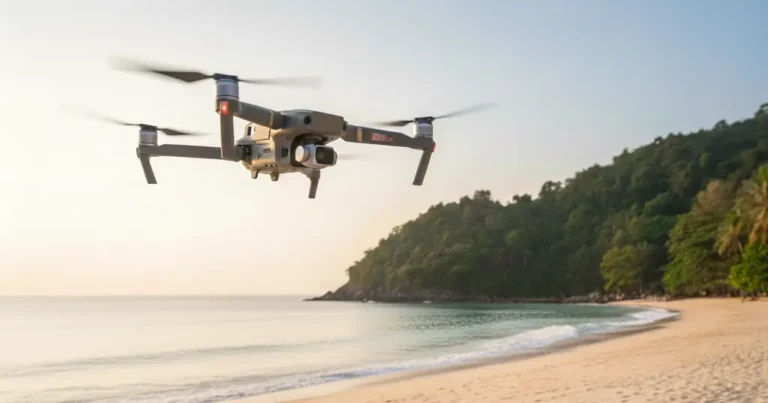
Modern imaging and military technology have developed rapidly, and drones have now become an important part of everyday life. People use drones to capture stunning aerial photos and videos, monitor dangerous areas, and even deliver goods to remote locations.
Because of these wide-ranging capabilities, drones are very popular – but they also come with legal responsibilities. Every drone user in Thailand needs to understand the basic regulations, registration rules, and flying restrictions before taking off.
This article explains the current drone laws in Thailand, including registration, permits, safety rules and no-fly zones.
What is a Drone?
A drone, formally called an unmanned aerial vehicle (UAV), is an aircraft that can fly without a pilot on board. It can be controlled remotely from the ground or follow a pre-programmed route.
Drones come in many sizes and shapes:
-
- From tiny devices that fit in the palm of your hand
-
- Up to larger drones comparable in size to a small airplane
Most drones are equipped with cameras that can capture high-quality photos and video from above.
Today, drones are widely used in many areas, both civilian and military, for example:
-
- Photography and video – aerial filming for movies, advertising, real estate, land surveys and tourism
-
- Agriculture – surveying crop areas, spraying pesticides or fertilizer, and monitoring plant health
-
- Logistics – delivering small packages to remote or hard-to-reach locations
-
- Search and rescue – locating and assisting victims in disaster zones or areas that are difficult to access
-
- Military and security – surveillance, reconnaissance and aerial operations
Because of this wide range of uses, the Thai authorities have issued specific drone regulations to ensure safety and protect public order.
What are the current drone laws in Thailand?
Below is a practical overview of the key rules for flying drones in Thailand, based on current regulations and the latest updates (B.E. 2567).
1. Drone Registration and Licensing
For many drones, registration is mandatory. In Thailand, two main authorities are involved:
-
- Civil Aviation Authority of Thailand (CAAT)
-
- National Broadcasting and Telecommunications Commission (NBTC / กสทช.)
1.1 CAAT – Drone Pilot / Operator Registration
Registration with CAAT is about the drone operator. This is similar to getting a “drone driving licence”.
-
- You register as the person who controls or releases the drone.
-
- CAAT checks your documents, insurance and basic competence before issuing approval.
Without CAAT approval (where required), you are not allowed to fly, even if the drone itself is registered or the frequency is licensed.
1.2 NBTC – Radio and Frequency Registration
Registration with NBTC relates to the radio equipment and frequency used by the drone:
-
- Drones use radio frequencies to communicate between the remote controller and the aircraft.
-
- You must register this radio equipment with NBTC or via its online platform.
Even if NBTC has approved your drone’s frequency use, you still must obtain CAAT approval (where required) before you can legally fly.
For drones weighing more than 25 kg, additional approval from the Ministry of Transport is required under a specific notification for heavy unmanned aircraft.
2. Which Drones Must Be Registered?
Under current practice and CAAT guidance, drones must be registered if they meet certain criteria
-
- Any drone equipped with a camera
-
- Must be registered, regardless of weight (for practical purposes, most camera drones fall in this group).
-
- Any drone equipped with a camera
-
- Drones without a camera weighing more than 2 kg (up to 25 kg)
-
- Must be registered with CAAT and NBTC.
-
- Drones without a camera weighing more than 2 kg (up to 25 kg)
-
- Drones weighing more than 25 kg
-
- Require specific written permission from the Minister of Transport, in addition to other approvals.
-
- Drones weighing more than 25 kg
-
- Drones that do NOT need registration
-
- No camera and
-
- Weight not more than 250 grams (very light toy-type aircraft)
-
- Drones that do NOT need registration
If your drone does not have a camera and weighs less than or equal to 250 g, it currently does not need to be registered with CAAT or NBTC, but you still must follow the operating rules when flying.
Validity and Penalties
-
- Drone and operator registrations typically remain valid for 2 years from the date of issue (check your specific approval).CAAT
-
- Flying without required registration can lead to serious penalties under the Air Navigation Act and related regulations, including:
-
- Imprisonment up to 1 year, or
-
- Fine up to 40,000 THB, or
-
- Both imprisonment and fine.
-
- Flying without required registration can lead to serious penalties under the Air Navigation Act and related regulations, including:
Breaches of NBTC radio regulations can carry even higher penalties (for example, fines up to 100,000 THB or imprisonment up to 5 years in some cases).More info
3. Safety Checklist Before Flying
Before every flight, the drone operator should carefully check both the drone and the legal requirements:
-
- Technical inspection
-
- Check that the drone is in good condition and safe to use.
-
- Inspect propellers, batteries, GPS, and all control systems.
-
- Technical inspection
-
- Verify registration and documents
-
- Make sure your drone and pilot registration are valid (CAAT + NBTC as applicable).
-
- Keep copies of your registration certificate and insurance policy with you while flying.
-
- Verify registration and documents
-
- Obtain landowner permission
-
- Always ask for permission from the landowner or person responsible for the area before flying over private property or controlled premises.
-
- Obtain landowner permission
-
- Study the area and flight altitude
-
- Understand the surrounding environment, terrain, people and potential obstacles.
-
- Confirm that your planned altitude and route are within legal limits (see Section 4).
-
- Study the area and flight altitude
-
- Plan for emergencies
-
- Prepare what to do in case of loss of signal, low battery or crash.
-
- Think about emergency landing spots and basic first aid if an accident occurs.
-
- Plan for emergencies
-
- Regular maintenance
-
- Follow the manufacturer’s instructions for maintenance and software updates.
-
- Keep a simple log of maintenance if you fly frequently or commercially.
-
- Regular maintenance
-
- Pilot competence
-
- The operator should be familiar with all systems and controls.
-
- You should also understand basic air traffic rules and local restrictions to reduce the risk of accidents.
-
- Pilot competence
-
- Carry registration and insurance documents
-
- Keep your CAAT registration, NBTC registration (if applicable) and third-party liability insurance with you whenever you fly.
-
- Carry registration and insurance documents
-
- Fire safety
-
- Carry basic fire-fighting equipment suitable for batteries and small electronic fires and make sure it is in working condition.
-
- Fire safety
-
- Mandatory drone insurance
-
- For most registered drones, you must have third-party liability insurance covering at least 1,000,000 THB per incident for bodily injury, death or damage to third-party property.
-
- The insurance policy should be attached to or kept with your drone registration documents and renewed at least 30 days before expiry.
-
- Mandatory drone insurance
4. Rules While Flying a Drone in Thailand
Once in the air, drone pilots must strictly follow CAAT’s operating rules. Key points include
-
- Do not fly in a dangerous manner
-
- Never operate in a way that could cause harm to life, body, property, or public order.
-
- Do not fly in a dangerous manner
-
- Respect restricted and prohibited areas
-
- Do not fly in restricted, prohibited or danger areas as published in Thai aviation notices.
-
- Avoid government buildings, military sites and hospitals unless you have written permission.
-
- Respect restricted and prohibited areas
-
- Clear take-off and landing path
-
- The path for take-off and landing must be free from obstacles that could endanger the drone or people.
-
- Clear take-off and landing path
-
- Maintain visual line of sight (VLOS)
-
- You must always be able to see your drone with your own eyes (no FPV-only flying).
-
- Do not rely solely on onboard cameras or VR goggles.
-
- Maintain visual line of sight (VLOS)
-
- Daylight operations
-
- Normally, drones may be flown between sunrise and sunset, when the aircraft is clearly visible.
-
- Daylight operations
-
- Avoid clouds
-
- Do not fly into or close to clouds where you may lose visual contact and control.
-
- Avoid clouds
-
- Keep away from airports
-
- Do not fly within 9 km (5 miles) of an airport or temporary airfield unless you have written permission from the airport operator.
-
- Keep away from airports
-
- Maximum altitude
-
- Maximum height is 90 metres (300 feet) above ground level, unless special permission is obtained.
-
- Maximum altitude
-
- No flying over crowds
-
- Do not fly directly over cities, villages, communities, or large gatherings of people to avoid injury in case of failure.
-
- No flying over crowds
-
- Stay clear of manned aircraft
-
- Never fly close to manned aircraft or interfere with normal air traffic.
-
- Stay clear of manned aircraft
-
- Respect privacy
-
- Do not use drones to invade privacy, such as filming or photographing people on private property without consent.
-
- Respect privacy
-
- Avoid nuisance or damage
-
- Do not fly in a way that causes disturbance, nuisance or damage to others (e.g., noise, dangerous low flying).
-
- Avoid nuisance or damage
-
- No dangerous goods or lasers
-
- You must not carry dangerous goods or attach laser devices to the drone unless specifically authorised.
-
- No dangerous goods or lasers
-
- Minimum distance from people and property
-
- For drones up to 2 kg: keep at least 30 metres (100 feet) horizontal distance from people, vehicles, buildings or structures not involved in the operation.
-
- For drones over 2 kg but not more than 25 kg: keep at least 50 metres (150 feet).
-
- Minimum distance from people and property
-
- Accident reporting
-
- If an accident occurs, the operator must notify the authorities without delay.
-
- Accident reporting
5. No-Fly Zones in Thailand
You must not fly a drone in certain high-risk or sensitive areas.
5.1 Areas where flying is strictly prohibited
Typically, these include:
-
- Areas around royal premises within a 19 km radius
-
- Military bases, training grounds and other restricted defence areas
-
- Areas around prisons and correctional facilities, often within 9 km
-
- Controlled police facilities and security zones
-
- Areas near airports within 9 km or as otherwise announced
These are high-security areas, and violations can result in severe penalties according to Drone Association Thailand+1
5.2 Areas where permission is required
Some locations are not automatically forbidden, but you must obtain prior written permission before flying, for example:
-
- Important government buildings such as Government House, Parliament, courts
-
- Areas with intense air traffic or major transport routes (highways, railways)
-
- Sensitive infrastructure: power plants, dams, large industrial facilities
-
- Protected natural areas: national parks, wildlife sanctuaries, conservation zones
-
- Public events and mass gatherings: festivals, concerts, big outdoor events
5.3 Checking no-fly zones with Google Earth
You can check many restricted zones using online tools:
-
- Download the Google Earth application.
-
- Visit the CAAT / drone map link (for example, via CAAT’s website or published maps).
-
- Areas marked in red are normally no-fly zones or require prior permission.
Always double-check the latest CAAT announcements, as temporary bans are sometimes issued for national security or special events.
6. How to Register and Get a Drone Permit in Thailand
The registration and permit process is usually divided into two parts:
6.1 Registering the drone with NBTC
This covers the radio equipment used to control the drone.
-
- Authority: NBTC (กสทช.)
-
- Channel: at NBTC office or online via the AnyRegis system. Here
Typical documents:
-
- Original ID card or passport of the owner
-
- Drone serial number
-
- Photos of the drone (for DIY drones, you may need to bring the drone)
-
- Completed NBTC registration form
-
- For shops: list of drones in stock (if registering multiple units)
6.2 Registering the drone operator with CAAT
This covers the person who controls or releases the drone.
-
- Authority: CAAT
-
- Channel: CAAT office or online via the UAS / UAV portal.
Typical documents:
-
- Online registration form via the CAAT portal
-
- For companies: company affidavit not older than 6 months
-
- Self-certification form signed by the applicant (for juristic persons, signed by all directors)
-
- Copy of ID card and house registration with certified true copy (for juristic persons, signed by all directors)
-
- Third-party insurance certificate with minimum coverage of 1,000,000 THB
-
- Photo of the drone clearly showing the serial number
After approval, keep both the NBTC and CAAT documents, together with the insurance policy, with you whenever you fly.
6.3 Drones that do not need registration
Under current rules, registration is not required if your drone:
-
- Has no camera, and
-
- Weighs not more than 250 grams.
However, you must still follow all operational rules and safety requirements when flying.
Summary
Flying a drone in Thailand is not as simple as just switching it on and taking off. To fly legally and safely, you must:
-
- Understand the registration rules with NBTC and CAAT
-
- Know which drones must be registered and which are exempt
-
- Follow detailed pre-flight checks and safety measures
-
- Comply with operational restrictions, including altitude, distance from people, airport safety and privacy
-
- Respect no-fly zones and obtain written permission where required
-
- Maintain valid third-party liability insurance and carry your documents while flying
By following the drone laws and regulations carefully, you help protect public safety and ensure that drone flying in Thailand remains safe, responsible and fully compliant with the law.