
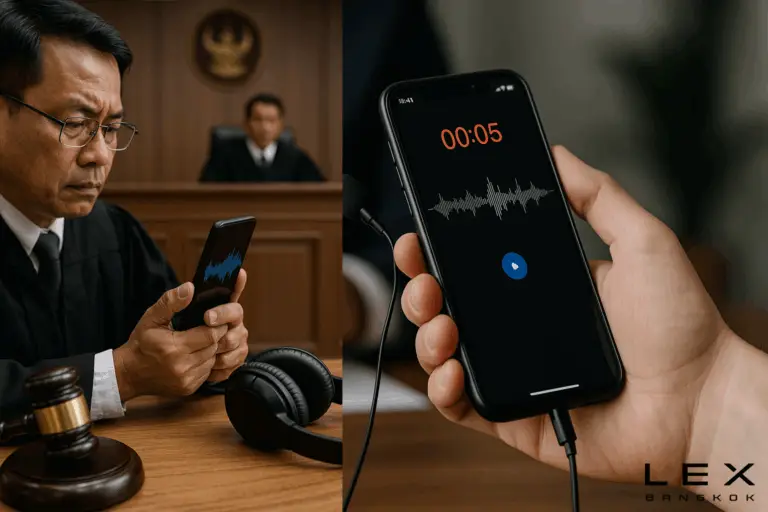
In Thailand, the use of secretly recorded audio evidence in court raises many legal questions. Can such recordings be accepted as valid evidence? The answer depends on whether the case is criminal or civil.
As many people wonder, if you secretly record a conversation, whether it’s an admission, a negotiation, or a private discussion, can that audio be used as evidence in a Thai court? So, Thai law provides strict rules about when secretly recorded audio evidence in Thailand can be used in criminal cases.
The answer depends on the type of case: criminal or civil, and how Thai law treats unlawfully obtained evidence.
In civil disputes, courts may allow secretly recorded audio evidence Thailand if it supports other reliable facts.
Criminal Cases: Evidence Obtained Illegally Is Generally Inadmissible
Under Section 226 of the Thai Criminal Procedure Code, evidence obtained unlawfully (such as unauthorized wiretaps, hidden audio recordings, or violating privacy rights) is not admissible. Courts generally will not consider such evidence, as it infringes on fundamental rights and fairness.
Case examples:
-
- Supreme Court Judgment No. 8575/2563 and 3782/2564 – Secret audio recordings without the other party’s knowledge were deemed unlawfully obtained and therefore inadmissible (e.g., defamation and private prosecution cases).
Exception: Serious Criminal Offenses and Justice Considerations
Section 226/1 introduces an exception. If the secretly recorded audio is a critical piece of evidence in a serious criminal case, and admitting it does not violate the principle of justice, the court may accept it.
Case example:
-
- Supreme Court Judgment No. 50/2563 – A hidden recording was admitted because the case involved serious criminal conduct, and the evidence was vital for proving the facts (e.g., drug trafficking, corruption).
Civil Cases: Secret Recordings May Be Accepted
In civil litigation, there is no specific prohibition against using unlawfully obtained evidence. Therefore, secretly recorded audio can be submitted, but the court will weigh its credibility and reliability.
Important factors include:
-
- Whether the audio was edited or altered (tampered recordings will be disregarded).
-
- Whether the recording aligns with other evidence presented.
Case examples:
-
- Supreme Court Judgment No. 4674/2543 and 3911/2534 – Courts allowed the use of secret recordings in civil disputes, as no law prohibits it and the evidence helped resolve the case.
Practical Takeaways
-
- Criminal cases → secret recordings are usually inadmissible, unless the case is serious and the evidence is essential (court discretion).
-
- Civil cases → recordings may be admitted, but credibility and weight are evaluated carefully.
-
- Risk → Making such recordings could still expose the recorder to separate liability (e.g., privacy violations).
Conclusion
Secretly recording someone is a legally grey area in Thailand. While civil courts may allow it, criminal courts usually reject it unless exceptions apply. If you are considering using such evidence, consult a lawyer first to assess whether it will strengthen your case, or create risks.
Need advice on litigation strategy or admissibility of evidence? Contact Lex Bangkok here to speak directly with our legal team.