

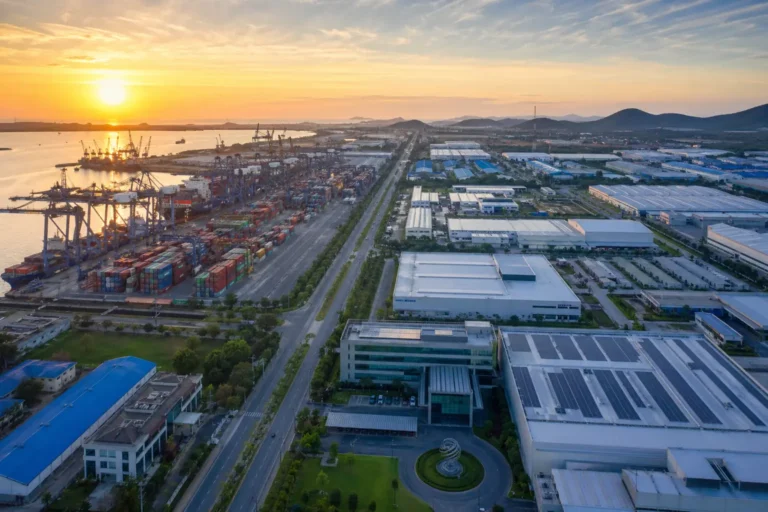
What the Eastern Economic Corridor Actually Is
The EEC is Thailand’s flagship special economic zone, governed by the Eastern Economic Corridor Act B.E. 2561 (2018). Its remit is to convert the country’s traditional Eastern Seaboard manufacturing base into a high-technology investment cluster aligned with Thailand 4.0 industrial strategy. The corridor is administered by the Eastern Economic Corridor Office (EECO), which coordinates incentives, infrastructure, and one-stop licensing across the three provinces. Light-industry investors can also review our guide to fashion and textile BOI incentives in Thailand to see which activities earn the longest exemptions.
Three layers of regulation operate simultaneously inside the EEC: the EEC Act itself, BOI promotion under the Investment Promotion Act, and Thailand’s general business and licensing regime (Foreign Business Act, Factory Act, Land Code). The EEC framework does not replace these — it overlays additional benefits onto qualifying projects in priority industries.
The Three EEC Provinces and Their Specializations
Chonburi — Automotive, Electronics, and Logistics Hub
Chonburi anchors the EEC’s industrial heartland. It hosts the deepest cluster of automotive original equipment manufacturers (OEMs) and tier-1 suppliers in Southeast Asia, the Laem Chabang deep-water port (Thailand’s largest container gateway), and Thailand’s most mature industrial estate ecosystem. Foreign manufacturers in automotive parts, consumer electronics, cold-chain logistics, and high-volume assembly typically locate here for proximity to Bangkok, the port, and a skilled industrial workforce.
Rayong — Petrochemicals, EV, and Heavy Industry
Rayong is Thailand’s petrochemical and heavy-industry capital, home to the Map Ta Phut Industrial Estate complex — the second-largest port complex in Thailand and the country’s primary chemicals and energy hub. The province has aggressively positioned itself as the EV manufacturing center, with major Chinese, Japanese, and European EV manufacturers locating final assembly and battery cell plants in Rayong’s industrial estates. New S-curve activities such as biofuels, advanced materials, and aerospace components are particularly well-suited here.
Chachoengsao — Aviation, Smart Manufacturing, and Future City
Chachoengsao is the youngest of the three EEC provinces in terms of foreign investment maturity, and that is precisely its strategic value. The province hosts U-Tapao International Airport, which is being redeveloped as the EEC’s aviation and aerospace hub, and Fueng Fa Smart City — Thailand’s flagship smart city development. Foreign manufacturers focused on aerospace MRO (maintenance, repair, overhaul), digital manufacturing, robotics, and food technology often select Chachoengsao for newer facilities at lower land cost than Chonburi.
EEC-Specific BOI Incentives: Enhanced Over Standard Promotion
EEC investors qualify for incentives layered on top of standard BOI promotion. The enhancements vary by activity category and target industry, but the core uplift includes:
- Additional CIT exemption years: Up to two extra years of corporate income tax exemption on top of the standard BOI grant for projects in EEC priority industries.
- 50% CIT reduction post-holiday: A five-year, 50% corporate income tax reduction following the end of the main CIT exemption period — effectively extending the tax benefit window.
- Personal income tax cap of 17%: Qualifying foreign experts and senior managers working on EEC-promoted projects pay personal income tax at a flat 17% rate, well below standard progressive rates that reach 35%.
- Faster approval timelines: EEC one-stop service centers offer expedited review for permits, work permits, and licensing.
- Long-term land lease rights: Up to 50 years renewable for one further 49-year term — a structure not available outside the EEC framework.
These benefits stack with the merit-based add-ons (R&D, training, local sourcing) available under standard BOI rules. For a high-technology automotive or EV project, the combined effect can mean an effective CIT-free or near-zero tax window of 13–15 years.
Smart Visa Eligibility for EEC Investors
The EEC framework anchors Thailand’s Smart Visa program. Foreign investors, executives, scientists, and high-level professionals working on EEC priority projects qualify for Smart Visa categories that include:
- Smart-T (Talent): Highly skilled scientists and senior experts in target industries.
- Smart-I (Investor): Foreign investors committing at least THB 20 million into a target industry company.
- Smart-E (Executive): Senior executives of companies operating in target industries.
- Smart-S (Startup): Founders of approved startups in priority industries.
- Smart-O (Other): Spouses and dependent children of Smart Visa holders.
Smart Visa benefits include up to four-year visas (versus standard one-year), exemption from work permit requirements, 90-day reporting waivers, and re-entry permit privileges. For senior expatriates relocating to manage EEC manufacturing operations, the Smart Visa is materially superior to the standard non-immigrant B visa plus work permit pairing.
Target Industries: S-Curve and New S-Curve
The EEC framework focuses incentives on twelve “S-curve” target industries — five existing industries Thailand wants to upgrade, and seven new industries Thailand wants to seed. Foreign manufacturers should map their planned activity to one of these categories to capture the full incentive stack:
Existing S-Curve (Five Upgrades)
Next-generation automotive (especially EV and connected vehicles), smart electronics, affluent medical and wellness tourism support industries, agriculture and biotechnology, and food for the future. These categories build on Thailand’s existing manufacturing base and are well-served by established supply chains in Chonburi and Rayong.
New S-Curve (Seven Seed Industries)
Robotics, aviation and logistics, biofuels and biochemicals, digital industry, comprehensive medical hub, defense industry, and education and human resource development. These categories are where the EEC is actively trying to attract foreign investment, and incentives are correspondingly generous. New S-curve activities frequently anchor in Chachoengsao or in newer Rayong industrial estates.
Key Industrial Estates Inside the EEC
The EEC contains over 30 industrial estates and zones, but a small group dominates foreign manufacturing investment. Estate selection materially affects access to one-stop licensing, infrastructure quality, neighbor-cluster effects, and resale value of facilities.
Amata City Chonburi and Amata City Rayong
Operated by Amata Corporation, the Amata estates are Thailand’s largest industrial estate operators by tenant count, with a heavy concentration of Japanese automotive and electronics manufacturers. Amata City Chonburi is the more mature site; Amata City Rayong attracts newer EV and high-tech entrants.
Hemaraj / WHA Industrial Estates
WHA Group operates multiple estates across Chonburi and Rayong, including WHA Eastern Seaboard 1–4 and Hemaraj Eastern Seaboard. WHA estates are known for one-stop licensing services, strong utilities infrastructure, and a balanced mix of automotive, electronics, and chemicals tenants. Many EV battery and BEV plants of major Chinese and European brands have located in WHA estates.
Map Ta Phut Industrial Estate
Operated by the Industrial Estate Authority of Thailand (IEAT), Map Ta Phut is the country’s largest petrochemicals complex. Foreign chemicals, polymers, and energy-related manufacturers locate here for direct access to feedstock pipelines and the deep-water port. Environmental compliance scrutiny is correspondingly high.
Laem Chabang Industrial Estate and Free Zone
Adjacent to Thailand’s largest container port, Laem Chabang Free Zone is the natural choice for export-oriented manufacturers needing port access for containerized shipping. Customs procedures are streamlined for free-zone tenants.
How Factory Licensing Differs Inside EEC Zones
The standard Ror Ngor 4 factory license regime under the Factory Act applies inside the EEC, but the administrative pathway is materially streamlined for tenants of designated industrial estates:
- One-stop service: Most major EEC estates host on-site IEAT or DIW representatives empowered to process factory license applications, building permits, and environmental clearances in parallel rather than serially.
- Pre-approved zoning: Land inside designated industrial estates is pre-zoned for industrial use under the Town Planning Act, eliminating the zoning checks that delay greenfield projects.
- Faster EIA review: Environmental Impact Assessment timelines are typically shorter inside estates with existing infrastructure and master EIA approvals, though project-specific EIAs remain required for heavy-industry activities.
- EECO coordination: EECO acts as the strategic coordinator, escalating delayed approvals to the relevant ministries and unblocking inter-agency disagreements.
This is a meaningful timeline compression. A standard greenfield Ror Ngor 4 application outside an industrial estate can take 90–180 working days; the same application inside a major EEC estate often completes in 60–90 working days when handled by experienced counsel.
Common Mistakes Foreign Investors Make in the EEC
Three recurring missteps cost foreign manufacturers months and millions in the EEC. The first is locking in land before confirming BOI eligibility — a wrong activity classification can disqualify the entire project from the EEC enhanced incentive stack. Always sequence the BOI pre-application before signing land binding agreements.
The second is choosing a province for cost reasons alone. Chachoengsao land is materially cheaper than Chonburi, but if your supply chain, workforce skills, or customer base sits in Chonburi, the operating-cost penalty over a 10-year horizon dwarfs the upfront land savings.
The third is underestimating Smart Visa eligibility. Many foreign investors default to standard non-immigrant B visas and work permits because their corporate consultants are unfamiliar with Smart Visa procedures, missing significant administrative and tax benefits for senior staff.
Frequently Asked Questions
Which provinces are part of the EEC in Thailand?
What additional BOI incentives does the EEC offer over standard promotion?
Who qualifies for the Smart Visa in the EEC?
Which industries are EEC target industries?
What are the main industrial estates inside the EEC?
How does factory licensing differ inside EEC industrial estates?
Related: Free Trade Zone in Thailand: Tax Haven Myth & Benefits
Planning EEC Investment in Thailand?
Lex Bangkok advises foreign manufacturers on EEC site selection, layered BOI and EEC incentive applications, Smart Visa structuring, and factory licensing inside industrial estates. We integrate corporate, immigration, and regulatory workstreams so your EEC project moves from due diligence to commissioning without permit gaps.
Schedule a Consultation延伸阅读 / Related guide: 泰国建厂完整指南 — Factory Setup in Thailand for Chinese Manufacturers.