

Lex Bangkok advises individuals, businesses, and international clients on debt recovery through demand letters, civil litigation, and court enforcement under Thai law.
Registered with the Lawyers Council of Thailand
Full bilingual communication for international clients
Demand letters and filings prepared for Thai courts
From the first notice to enforcement — structured legal support at every stage.
Court-compliant demand letters drafted in Thai and English, delivered via registered mail to meet court requirements.
Full representation in Thai civil courts from case filing through judgment.
Post-judgment enforcement to recover money through asset seizure and garnishment.
Out-of-court resolution when possible — payment plans, settlements, and mediation.
Recovering unpaid debts in Thailand requires early legal action, proper documentation, and a clear enforcement strategy. Many creditors delay action, assuming debtors will eventually pay. In practice, delay often results in asset dissipation, avoidance, or legal time bars.
Thailand follows a formal civil law system. Debt recovery is not based on informal pressure or collection agencies, but on documented legal steps that courts expect creditors to follow.
The first step in any debt recovery case is sending a legal demand letter, which is a formal requirement under Thai law. Understanding the notice requirements in Thai law is essential before proceeding to court.
At Lex Bangkok, we represent clients in debt recovery and demand letter services in Bangkok — guiding cases from the first formal notice through litigation and court-ordered enforcement.
All attorneys are registered with the Lawyers Council of Thailand with courtroom litigation experience.
Full communication in Thai and English — so international clients understand every step of their case.
Every demand letter and filing is drafted to meet Thai court standards from the first step.
We pursue enforcement through asset seizure, garnishment, and property execution — not just judgments on paper.
We give honest advice on recovery prospects before investing in legal action.
Every case receives a tailored strategy — from negotiation to litigation, depending on the specific circumstances.
Thai law follows a structured approach. Each step must be properly documented.
A formal demand letter is the first legal action in Thailand. It notifies the debtor and sets a deadline for payment. Most debts are resolved at this stage.
If the debtor does not respond, a civil case may be filed in Thai court. The court reviews contracts, evidence, and hears both parties.
Winning a case is not the end. If the debtor refuses to pay, enforcement measures are available through the court.
Recovering unpaid debts in Thailand requires early legal action, proper documentation, and a clear enforcement strategy by a Debt Recovery Lawyer in Thailand. Many creditors delay action, assuming debtors will eventually pay. In reality, delay often results in asset dissipation, avoidance, or legal time bars. The first step in any debt recovery case is sending a legal demand letter for debt recovery, which is a formal requirement under Thai law.
At Lex Bangkok, we represent individuals, businesses, and international clients in debt recovery and demand letter services in Bangkok and throughout Thailand — guiding cases from the first formal notice through litigation and court-ordered enforcement. Understanding the notice requirements in Thai law is essential before proceeding to court, and our team ensures every step is properly documented. Learn more about why sending a demand letter is the best first step for debt recovery in Thailand.
Thailand follows a formal civil law system. Debt recovery is not based on informal pressure or collection agencies but on documented legal steps that courts expect creditors to follow.
A successful recovery typically depends on:
Proper issuance of a legal demand letter
Strong written evidence
Timely filing within prescription periods
Effective enforcement after judgment
Skipping steps or using improperly drafted letters can weaken your position in court.
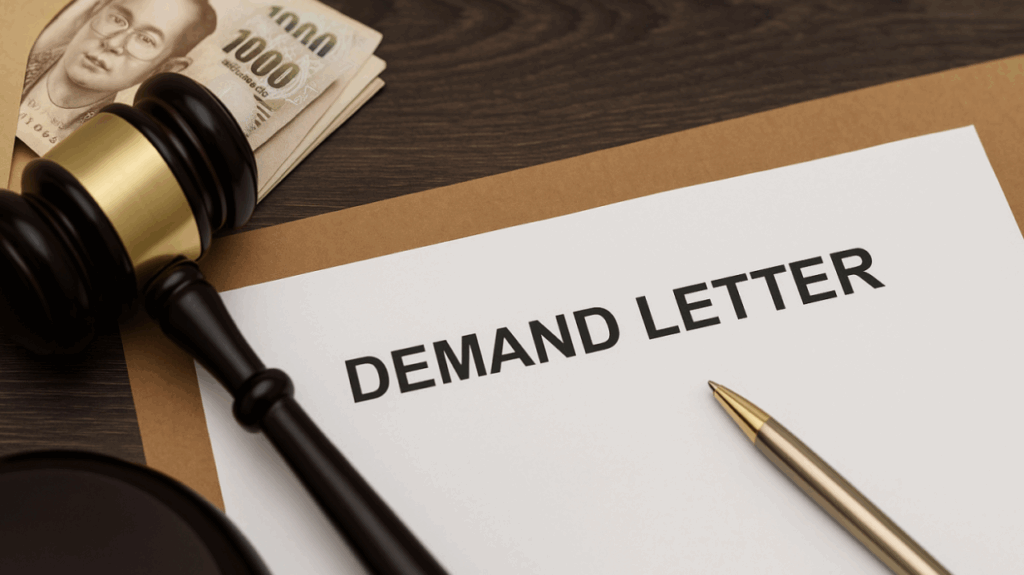
A demand letter is usually the first formal legal action in Thailand.
It:
Notifies the debtor of the legal claim
Sets a clear repayment deadline
Preserves your rights before court action
Demonstrates good-faith effort to resolve the dispute
In many cases, payment occurs at this stage.
If the debtor ignores the demand letter, a civil claim may be filed in Thai court.
The court will:
Review contracts, loans, invoices, and evidence
Hear debtor defenses
Issue a binding judgment
Litigation creates a legally enforceable obligation, not just a request for payment.
If the debtor still refuses to pay, enforcement measures are available through the court.
These include:
Seizure of movable and immovable assets
Garnishment of wages or income
Freezing bank accounts
A judgment without enforcement is ineffective, execution is critical.
A professionally drafted demand letter is not a simple reminder letter. It is a legal instrument.
Why Courts Take Demand Letters Seriously
Demonstrates creditor reasonableness
Shows opportunity for settlement
Creates a clear timeline of default
Strengthens claims for interest and damages
Judges often ask whether a demand letter was issued before litigation.
What Our Demand Letters Include
Clear identification of creditor and debtor
Exact debt amount and legal basis
Reference to agreements and Thai law
Payment deadline (typically 7–15 days)
Warning of civil and enforcement actions
Proper delivery via registered or legal channels
Demand letters are issued in Thai and English, depending on the debtor profile.
If payment is not made, court action may be necessary.
Common Types of Debt Claims
Personal loans and private lending
Unpaid invoices or service fees
Rental and lease disputes
Breach of contract
Bounced cheques
Fraud-related monetary claims
Required Documentation
Written agreements or loan evidence
Proof of transfer or payment
Demand letters and delivery proof
Communication records (messages, emails)
The strength of documentation directly impacts speed and success.
Winning a case is not the end. Enforcement ensures recovery.
Enforcement Measures Available
Vehicle and property seizure
Income garnishment
Bank account attachment
Public auction of seized assets
Legal Time Limits
Loan claims: 10-year prescription period
Enforcement: Must commence within 10 years of enforceability
We advise enforcement strategies early to prevent asset concealment.
Secured Debts and Collateral Enforcement
For debts secured by collateral (e.g., mortgages or guarantees), Thai law often requires pre-action written notice, commonly 60 days, before enforcement is permitted.
Failure to comply may delay or invalidate enforcement actions. We ensure compliance before proceeding.
A legal demand letter is a formal written notice issued by a lawyer demanding repayment of an outstanding debt within a specified timeframe. It states the legal basis of the claim, the amount owed, and warns of court action if payment is not made. In Thailand, demand letters are often the first and most effective step in debt recovery.
While not always legally mandatory, Thai courts strongly expect creditors to issue a demand letter before initiating a civil lawsuit. Issuing a demand letter demonstrates good faith, strengthens your case, and may influence the court’s assessment of interest, damages, and costs.
Typically, a payment deadline of 7 to 15 days is used, depending on the nature of the debt and urgency. For certain secured debts, Thai law may require longer pre-action notice periods before enforcement.
If the debtor ignores the demand letter or refuses to pay, the next step is to file a civil lawsuit in the appropriate Thai court. The demand letter then becomes key evidence showing that the debtor was formally notified and failed to comply.
Yes. Debts can be pursued against:
Jurisdiction depends on where the debtor resides, where the contract was performed, or where assets are located.
The timeline varies depending on complexity and debtor response:
Early legal action significantly shortens the overall process.
We handle debt recovery for:
Both written and informal loan arrangements may be enforceable with proper evidence.
If the debtor still refuses to pay after judgment, Thai law allows:
Enforcement must be initiated within legal time limits.
Yes. In general:
Delays may permanently bar recovery, so timely action is critical.
Yes. Lex Bangkok provides bilingual services. Demand letters and legal advice can be prepared in Thai and English, ensuring clarity for both Thai and international debtors while remaining court-compliant.
If you have an outstanding debt to recover in Thailand, contact our team for an initial assessment of your case and available legal options.
Strategic, professional, results-driven legal support