

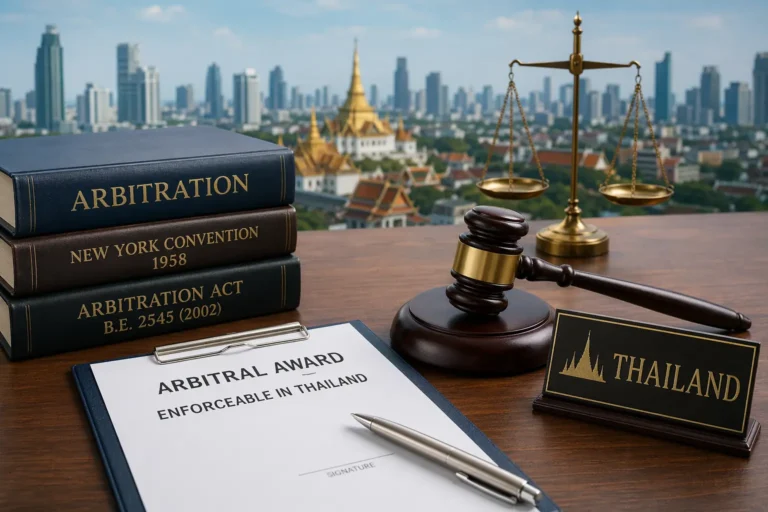
The recent legal proceedings initiated by ONE Championship against Thai Muay Thai athlete Rodtang Jitmuangnon across Singapore, Japan, and Thailand have placed a renewed spotlight on a question that matters for anyone doing business in Asia: how does the enforcement of foreign arbitral awards Thailand actually work in practice?
For foreign investors, multinational corporations, sports organizations, and international talent agencies, the answer is decisive. A favorable arbitral award obtained in Singapore, London, or New York is only valuable if it can be converted into a real, enforceable remedy against assets located in Thailand. Thai law — anchored by the New York Convention and the Arbitration Act B.E. 2545 (2002) — provides a reliable, fast-track mechanism for doing exactly that. This guide explains the framework, the timeline, the grounds for refusal, and the practical steps international parties should take to protect their contractual rights in cross-border disputes touching Thailand.
Why Singapore Law Often Governs Contracts Enforced in Thailand
Many international commercial contracts performed in Thailand are deliberately governed by foreign law. Singapore law is particularly popular because Singapore is recognized as one of the leading arbitration seats in Asia, its courts strictly enforce contractual obligations, and its judicial system is widely regarded as neutral and commercially sophisticated.
When parties sign an international agreement — a fighter contract, a distribution agreement, a joint venture, or a licensing deal — they are generally free to choose the governing law. Common choices include Singapore law, English law, Thai law, or the law of the counterparty’s home jurisdiction. Where the parties agree on Singapore law, the arbitral tribunal applies Singapore legal principles to determine whether a breach has occurred, regardless of the nationality of the defendant. A Thai national who signs a Singapore-law contract is bound by that choice.
The Role of the Arbitration Clause: Excluding National Courts
International commercial contracts typically include an arbitration clause. When they do, that clause effectively excludes the jurisdiction of national courts. If one party tries to sue in a Thai court despite the arbitration agreement, the other party can petition the court to dismiss the action and refer the dispute back to arbitration.
This principle is well-settled in Thailand. Thai courts respect arbitration agreements and routinely decline to hear substantive disputes that belong before an arbitral tribunal. In disputes involving international sports organizations, technology firms, or multinational manufacturers, arbitration typically proceeds in Singapore before arbitrators with deep expertise in sports law, commercial contracts, or the specific industry involved.
Confidentiality: A Key Commercial Advantage of Arbitration
Unlike Thai court proceedings, which are public, arbitration hearings are confidential. Commercial terms, alleged misconduct, and the details of the dispute generally remain private. Once the tribunal concludes its review, it issues a binding decision known as an arbitral award, which carries the same legal weight as a final court judgment. For reputation-sensitive disputes — athlete contracts, executive compensation, intellectual property, licensing royalties — confidentiality is often a decisive commercial advantage.
Enforcement of Foreign Arbitral Awards Thailand: The Legal Framework
Thailand is a contracting state to the 1958 New York Convention on the Recognition and Enforcement of Foreign Arbitral Awards, which has more than 170 member states. Domestically, enforcement is governed by the Arbitration Act B.E. 2545 (2002).
Section 41 of the Arbitration Act B.E. 2545
Section 41 of the Arbitration Act provides that arbitral awards are binding on the parties regardless of the country in which the award was made, provided the country is a party to a treaty or convention to which Thailand is also a party. Once a petition for enforcement is filed with a competent Thai court, the court is required to enforce the award, subject only to the narrow grounds for refusal set out in the Act.
The Three-Year Filing Deadline
A critical procedural point that international creditors frequently overlook: under Thai law, the party seeking enforcement must file a petition with the competent Thai court within three years from the date the arbitral award becomes enforceable. Missing this deadline can permanently extinguish the right to enforce.
Thai Courts Do Not Re-Examine the Merits
One of the most important — and most misunderstood — features of the system is that Thai courts will not re-examine the merits of the underlying dispute. The court does not reconsider whether a breach of contract actually occurred, whether the damages were correctly calculated, or whether the tribunal applied the governing law correctly. Its role is strictly limited to reviewing the legal validity of the arbitration process itself. This is precisely what makes arbitration so efficient for cross-border disputes: a winning party does not need to re-litigate the case in Thailand.
Limited Grounds for Refusing Enforcement
Under the New York Convention and the Arbitration Act, a Thai court may refuse enforcement only on narrow, procedural grounds. These include:
- Incapacity of a party at the time the arbitration agreement was concluded
- Improper notice of the arbitration proceedings or of the appointment of the arbitrator
- An award that exceeds the scope of the arbitration agreement
- Irregular composition of the tribunal or procedure contrary to the agreement of the parties
- The award is not yet binding, or has been set aside or suspended in the seat of arbitration
- The subject matter is not arbitrable under Thai law
- Enforcement would be contrary to Thai public policy
The debtor bears the burden of proving these grounds. In practice, Thai courts have taken a pro-enforcement stance consistent with Thailand’s treaty obligations under the New York Convention.
What Enforcement Looks Like in Practice
Once the Thai court recognizes and enforces the foreign arbitral award, the successful party obtains full status as a judgment creditor under Thai law. From that moment, the creditor may proceed with standard enforcement measures, including:
- Seizure of immovable property, including land, condominiums, and commercial real estate
- Seizure of movable assets such as vehicles, equipment, and inventory
- Freezing of bank accounts held in Thai financial institutions
- Attachment of shares in Thai companies
- Garnishment of receivables owed to the debtor by Thai counterparties
From this stage onward, the debtor is treated as a judgment debtor and has no right to re-argue the substantive dispute.
Interim Measures: Protecting Assets While Arbitration Is Ongoing
A commonly overlooked but highly valuable tool is found in Section 16 of the Arbitration Act. This provision allows a party involved in foreign arbitration proceedings to apply directly to a Thai court for interim measures of protection, even while the arbitration is still pending abroad.
Typical interim measures include asset-freezing orders to prevent the debtor from selling property, injunctions preventing the dissipation or transfer of funds out of Thailand, and orders preserving evidence located in Thailand. These measures are decisive for creditors worried that, by the time a final arbitral award is issued, the debtor’s Thai assets will have been hidden or transferred. Acting quickly on interim relief often determines whether a later award is collectible at all.
Practical Takeaways for International Parties
For Foreign Companies Operating in Thailand
Confirm that your commercial contracts include a well-drafted arbitration clause specifying the seat (typically Singapore), the governing law, the institution (e.g., SIAC), and the language. A precisely worded clause is the foundation of enforceability in Thailand. Conduct asset mapping early so that, if a dispute arises, you already know where the counterparty’s Thai assets are located.
For Athletes, Entertainers, and Talent Contracts
Athletes, artists, and high-profile talent frequently sign international contracts governed by foreign law without fully understanding the enforcement consequences in Thailand. A breach — refusing to perform, competing for a rival, or unauthorized endorsements — can lead to a foreign arbitral award that is later enforced against Thai bank accounts, real estate, and sponsorship receivables. Talent and their representatives should obtain Thai legal advice before signing, not after a dispute erupts.
For International Business and Licensing Agreements
Cross-border licensors, franchisors, distributors, and joint-venture partners should treat the arbitration clause as a commercial asset, not boilerplate. Well-structured clauses produce awards that are enforceable in Thailand within a predictable timeline and budget. Poorly drafted clauses — ambiguous seat, conflicting governing law, non-signatory issues — create expensive gateway disputes before the merits are even reached.
Why This Matters for Cross-Border Business in Thailand
The ability to convert a foreign arbitral award into real, enforceable remedies in Thailand is one of the single most important legal protections available to international businesses operating in or trading with Thailand. It transforms a piece of paper issued in Singapore or London into the practical power to seize a condominium in Sukhumvit, freeze a bank account in Silom, or attach shares in a Bangkok-registered subsidiary.
Because Thai courts are restricted from re-examining the merits, the risk of a well-drafted contract being litigated twice — once abroad and once in Thailand — is significantly reduced. This cost and time saving is precisely why international parties continue to favor arbitration seated in Singapore, Hong Kong, or London for contracts with a Thai nexus.
Frequently Asked Questions
How long does enforcement of a foreign arbitral award in Thailand typically take?
Can a Thai court refuse to enforce a foreign arbitral award if it believes the tribunal got the decision wrong?
What if the contract is governed by Thai law instead of Singapore law — does enforcement still work the same way?
Can I freeze my counterparty’s Thai assets before the arbitration concludes?
Do I need to hire a Thai lawyer if my arbitration is seated in Singapore?
Related reading: how to draft an arbitration clause in Thailand that holds up, covering seat, institution and the Supreme Court’s reading of permissive wording.
Enforcement changes character once the award debtor enters a Thai insolvency process. Our note on arbitration and insolvency in Thailand sets out what happens to an award you already hold.
Need Help Enforcing a Foreign Arbitral Award in Thailand?
Lex Bangkok’s cross-border disputes team advises international clients on enforcing foreign arbitral awards, obtaining urgent asset-protection orders, and drafting arbitration clauses that hold up under pressure. Timing is often decisive — particularly when interim measures or the three-year enforcement window are in play.
Schedule a ConsultationRelated reading: Lex Bangkok Named Finalist in the 2025 Altaris Small Business Awards · Arbitrator Independence in Thailand: 2026 Legal Guide
Related reading: Once an award is recognised, execution costs apply. Read our note on the current enforcement fees in Thailand before you budget a recovery strategy.