

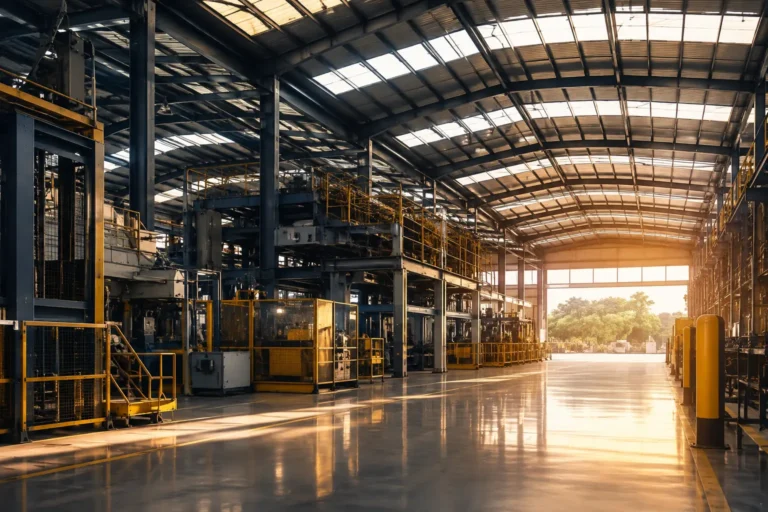
Why Factory Heat in Thailand Is a Legal Question
Thai law does not require you to insulate a roof. It does require three other things. You must keep workplace heat within a prescribed standard. You must measure it. In many cases you must also report your energy performance to the state each year. Insulation is therefore not a duty in itself. Instead, it is the practical means of discharging duties that already bind you.
Three regimes matter here, and operators routinely confuse them:
- Occupational safety law. This regulates the heat your employees actually experience.
- Energy conservation law. This governs how much energy your site consumes and how you account for it.
- The Factory Act. This, with the conditions attached to your licence, governs the building itself.
The Occupational Safety Duty You Already Owe
The Ministerial Regulation on the Standard for Administration and Management of Occupational Safety, Health and Environment in relation to Heat, Light and Noise B.E. 2559 (2016) sits under the Occupational Safety, Health and Environment Act B.E. 2554 (2011). It applies to employers generally, not only to heavy industry.
In outline, an employer must do four things.
- Keep heat within the standard. The permitted level uses a wet bulb globe temperature and varies with the physical intensity of the work. Light, medium and heavy tasks therefore differ. A packing line and a foundry are not judged alike.
- Measure it. Where the operation involves a hot process, the employer must measure heat levels at least once a year.
- Report the results. The measurement results go to the authorities within 30 working days.
- Protect and monitor employees. That covers appropriate personal protective equipment together with health checks and the associated reporting.
Notice what this structure does. It creates a written, dated record of the temperature inside your building, filed with a regulator. Consequently, a site that measures above the standard has documented its own exposure. Our guide to occupational safety compliance in Thailand covers the wider obligations that sit alongside this one.
The Building Energy Code Probably Does Not Apply to You
Here foreign investors are frequently misadvised. Thailand does operate a Building Energy Code, introduced by the Ministerial Regulation prescribing the type or size of building and the standards, criteria and procedure for designing buildings for energy conservation B.E. 2563 (2020). The code sets thermal transfer limits for the building envelope and roof. It applies to new or substantially modified buildings of at least 2,000 square metres. Enforcement reached privately owned buildings in March 2023.
However, the regulation targets nine listed building types. Those include offices, hotels, hospitals, schools, department stores, condominiums, theatres, exhibition halls and entertainment venues. Factories and warehouses do not appear on that list.
The practical consequence surprises people. Your production building faces no envelope-performance test at the design stage, and no one will refuse your construction permit over roof insulation. Nevertheless, the absence of a design standard is not an exemption. The heat and energy duties still apply once the building operates. In short, the obligation arrives later rather than never.
Designated Factories and the Annual Energy Report
The Energy Conservation Promotion Act B.E. 2535 (1992), as amended, imposes a distinct set of obligations on larger energy users. A site becomes a “designated factory” once it crosses any one of three thresholds. Those are an installed electricity meter above 1,000 kW, installed transformers above 1,175 kVA, or annual energy consumption above 20 million megajoules.
Designated factories fall into two groups by size. Each must appoint a person responsible for energy, and larger sites must appoint more than one, including a senior appointee. Each must also operate an energy management system and submit an annual report to the Department of Alternative Energy Development and Efficiency.
Cooling load matters directly here. An uninsulated roof drives air-conditioning and ventilation demand, which raises consumption, which in turn feeds the report you file each year. Moreover, sites sitting just below a threshold can cross it as cooling demand rises, and the obligations then attach.
Where Your Factory Licence Fits In
The Factory Act B.E. 2535 (1992), as amended in 2019, governs the operation of the plant itself. Licensing conditions and the applicable ministerial regulations address matters such as building suitability, ventilation and worker welfare. Inspectors assess the site as it actually operates rather than as it appeared on the original drawings.
Accordingly, thermal performance is worth settling before you build rather than after an inspection raises it. Investors planning a new plant should read our guidance on the factory licence in Thailand alongside our note on factory layout and design. Envelope decisions and layout decisions constrain each other.
Managing factory heat in Thailand therefore begins on the drawing board rather than on the maintenance schedule.
Promoted projects have a further angle. Investors should also check whether envelope and efficiency upgrades qualify for support, because our overview of BOI manufacturing incentives explains how measures of this kind can be treated.
What Factory Heat in Thailand Costs You Commercially
Operational arguments for insulation are familiar: cooler air, steadier machinery, less spoilage in storage, lower electricity bills. Those arguments are sound, yet they undersell the position. Above all, four points carry more weight in a board paper.
- Documented exposure. Annual heat measurement creates evidence. That evidence then supports claims, inspections and, in a serious case, personal liability for managers.
- Workforce stability. Heat drives attrition and absenteeism in Thai plants, and replacing skilled line staff costs far more than a roof.
- Customer audits. International buyers increasingly audit working conditions and energy performance. As a result, a failed social-compliance audit can close a supply relationship faster than any regulator.
- Asset protection. Temperature-sensitive stock and process equipment degrade quietly, and the loss rarely appears as a single visible incident.
Frequently Asked Questions
Does Thai law require factory roof insulation?
How often must we measure factory heat in Thailand?
Does the Building Energy Code apply to a new warehouse?
When does our plant become a designated factory?
Conclusion
Rising temperatures have turned a comfort question into a compliance one. Factory heat in Thailand now touches occupational safety filings, annual energy reporting and the conditions under which your plant holds its licence. Some operators treat the building envelope as deferred maintenance. Those who treat it instead as part of their regulatory position tend to meet inspections and customer audits without drama.
Planning or Upgrading a Plant in Thailand?
Lex Bangkok advises international manufacturers and industrial investors on factory licensing, occupational safety obligations, energy compliance and BOI-promoted projects. Getting the regulatory position right at design stage costs far less than retrofitting under an inspection deadline.
Request a Factory Compliance ReviewThis article provides general information on Thai law and does not constitute legal advice. Obligations vary with the activity, the size of the site and the terms of each licence. Obtain advice on your own operation before acting. Guidance is published by the Ministry of Labour and the Department of Alternative Energy Development and Efficiency.