


What the New Notification Actually Says
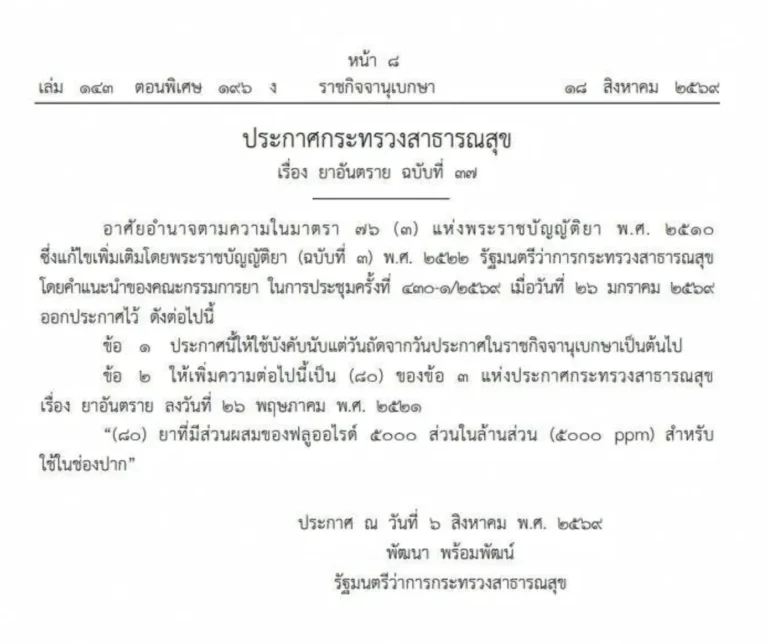
First, the sequence of events. The Ministry of Public Health issued the Notification on Dangerous Drugs (No. 37) on 6 August 2026. The Royal Gazette published it on 18 August 2026, at Volume 143, Special Part 196 Ngor, page 8. Under clause 1, it took effect the following day.
The Minister issued it under section 76(3) of the Drug Act B.E. 2510 (1967), as amended by the Drug Act (No. 3) B.E. 2522 (1979), acting on the recommendation of the Drug Committee at its meeting of 26 January 2026. In substance, the notification does one narrow thing. It adds a new item (80) to the long-standing list of dangerous drugs that the Ministry first issued on 26 May B.E. 2521 (1978). That item now covers “medicine containing fluoride 5,000 parts per million (5,000 ppm) for oral use”.
This is binding law rather than a consultation or a draft. Accordingly, businesses handling high-concentration products should treat the compliance clock as already running.
Ordinary Fluoride Toothpaste in Thailand Is Unaffected
Public reaction to the notification was predictable, and the Thai FDA moved quickly to correct it. In particular, the regulator confirmed three points.
- Fluoride prevents tooth decay, and correct brushing with a fluoride paste remains accepted dental practice.
- Toothpaste containing fluoride at or below 1,500 ppm still counts as a cosmetic. In short, the notification changes nothing for those products.
- The label “dangerous drug” is a statutory sales-control category. It does not mean the substance is poisonous, and it does not signal that consumers should switch products.
Most retail toothpaste on Thai shelves sits between 1,000 and 1,500 ppm. Consequently the everyday market stays untouched, and brands in that band face no new approvals.
Why the Reclassification Happened
The change responds to a genuine clinical gap rather than a safety scare. Thailand’s ninth National Oral Health Survey, published in 2023, recorded tooth decay across every age group: 49.7% at age twelve, 61.2% at fifteen and 80.9% among working-age adults. Root decay affected 29.1% of older people, rising to 82.4% among those who depend on others for care.
By contrast, certain patients face far sharper risk. Oral cancer patients who receive radiotherapy lose salivary function, and decay rates among them reach 74% within seven years of treatment. For those groups, standard-strength paste often proves insufficient.
As a result, high-concentration formulations fill a genuine therapeutic need, and the classification simply reflects that purpose. Even so, the FDA advises that patients should follow the recommendation of a dentist or pharmacist. It also cautions against use in children under twelve, because young children may swallow the paste.
The Commercial Consequence: A Cosmetic Becomes a Drug
For any business importing, manufacturing or selling a 5,000 ppm product, the practical effect is a wholesale change of regime. Above all, four consequences deserve immediate attention.
- Product approval. A cosmetic notification no longer suffices. The product needs drug registration instead, which involves a different dossier, different evidence and a materially longer timeline. Our guide to drug registration in Thailand sets out that process.
- Licensing. Manufacture, import and sale of drugs each require their own licence under the Drug Act. Permissions held for cosmetics do not carry across, so an established cosmetics importer may still be unlicensed for this single SKU.
- Sales channel. Dangerous drugs may only reach the public through licensed pharmacies with a pharmacist on duty. Supermarkets, convenience stores and open marketplace listings therefore fall outside the permitted channel.
- Advertising. Drug advertising requires prior approval, and the Drug Act restricts advertising the therapeutic properties of dangerous drugs to the general public. Influencer content and marketplace product copy are the usual points of exposure, as our note on advertising rules for regulated products explains.
Action Points for Anyone Selling Fluoride Toothpaste in Thailand
- Verify actual concentration. Test and document the fluoride content of every oral SKU, because supplier specifications are not evidence.
- Map your portfolio. Separate cosmetic-band products from anything at or near 5,000 ppm, then treat the two groups as entirely different businesses.
- Check the licences first. Confirm drug import, manufacture or sale licences before the next shipment clears, not afterwards.
- Fix the channel. Withdraw affected products from general retail and from open e-commerce listings until the position is regularised. Sellers should review our online seller compliance guidance.
- Rewrite the marketing. Pull consumer-facing therapeutic claims, and brief resellers and influencers in writing.
Meanwhile, foreign brands entering the market face the same analysis in reverse. Similarly, anyone planning a launch should classify the product before designing the packaging, because the two regimes demand different labels. Our experience with cosmetic brand registration with the Thai FDA shows how often classification settles far too late.
Frequently Asked Questions
Can supermarkets still sell fluoride toothpaste in Thailand?
What does “dangerous drug” mean under Thai law?
Can we import a 5,000 ppm product under our existing cosmetic licence?
Who is the high-concentration product intended for?
Conclusion
Regulatory risk rarely arrives as a headline. Instead, it arrived here as a single numbered item added to a notification from 1978. Fluoride toothpaste in Thailand remains an ordinary consumer product for almost every brand on the market. Nevertheless, for the narrow group handling 5,000 ppm formulations, the compliance burden changed overnight, and the exposure covers registration, licensing, distribution and advertising at the same time.
Is Your Product on the Right Side of the Line?
Lex Bangkok advises international manufacturers, importers and distributors on Thai FDA classification, product registration and licensing across drugs, cosmetics, supplements and medical devices. Classification decided early costs a fraction of classification corrected later.
Request a Product Classification ReviewThis article provides general information on Thai regulatory law and does not constitute legal advice. Classification depends on the specific formulation, presentation and claims made for each product. Obtain advice on your own portfolio before acting. The notification appears in the Royal Gazette, and the Thai Food and Drug Administration publishes product classification guidance.