

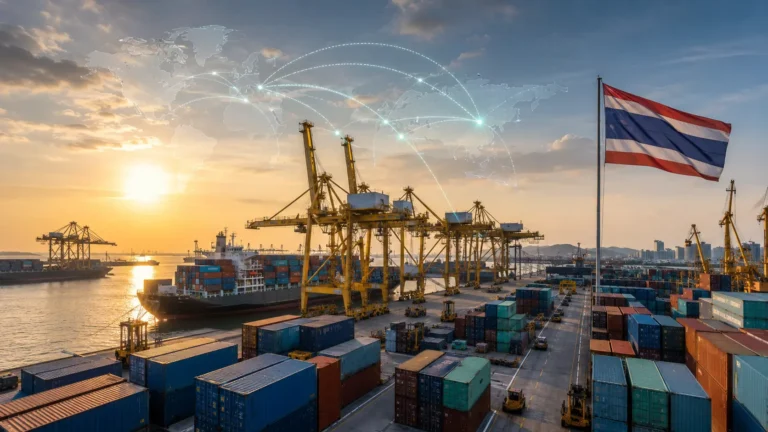
Why Rules of Origin Have Become Thailand’s Biggest Trade Risk
Throughout 2025, exporters in Thailand focused heavily on the headline reciprocal tariff rates negotiated between Bangkok and Washington. That focus is now misaligned with the real enforcement landscape. Regulators in both the United States and the European Union are scrutinizing whether goods declared as Thai actually meet the legal threshold for Thai origin — and whether shipments routed through Thailand involve unlawful transshipment of Chinese or other foreign-origin inputs.
Related reading: origin documentation will soon matter for labor risk too — see the new Thailand forced labor import controls.
Exporters tightening origin paperwork should also review the new Thailand dual-use export controls, which add licensing duties for Category 0 goods from July 2026.
Three forces are converging:
- The US Supreme Court’s February 2026 ruling invalidating the use of the International Emergency Economic Powers Act (IEEPA) as a basis for reciprocal tariffs, which has destabilized the duty schedule applied to Thai exports.
- An expanding US enforcement program built on Section 232, Section 301, anti-dumping, countervailing, and Trade Facilitation and Trade Enforcement Act (TFTEA) authority — none of which were affected by the IEEPA decision.
- EU anti-circumvention investigations triggered by sudden shifts in trade patterns from China to Thailand and other ASEAN hubs in sectors such as solar modules, e-bikes, electrical steel, and tyres.
For Thai-based manufacturers, particularly those whose investment thesis relies on access to the US and EU markets, the legal defense of origin has become the single most important compliance discipline of 2026.
What the US Supreme Court’s IEEPA Decision Changed
The IEEPA framework underpinned much of the 2025 reciprocal tariff regime, including the 19% rate applied to a wide range of Thai-origin goods following the 2025 Framework for an Agreement on Reciprocal Trade. The Supreme Court’s February 2026 ruling held that IEEPA does not provide statutory authority to impose tariffs of this nature, removing the legal anchor for those duties.
However, the ruling did not dismantle the underlying enforcement infrastructure. The US administration has publicly indicated that replacement tariffs will be pursued under Section 122, Section 232, and Section 301 authorities, each of which carries its own procedural pathway and judicial review standard. More importantly, circumvention enforcement under TFTEA, the Enforce and Protect Act (EAPA), and Customs and Border Protection’s audit powers remains entirely unaffected.
What this means for Thai exporters
Even where IEEPA-based duties have been refunded or suspended, importers of record in the United States continue to face exposure on three fronts: substantial transformation determinations on goods declared as Thai-origin, EAPA investigations into alleged transshipment, and customs audits seeking retroactive duty assessments going back five years. Thai suppliers whose contracts contain origin warranties may be liable for indemnification under those clauses.
Substantial Transformation: The Test That Decides Everything
Under both US and EU customs law, a product’s country of origin is the country where it underwent its last substantial transformation. The doctrine sounds simple but is highly fact-specific. In Thai supply chains that import components from China, Vietnam, or Malaysia and assemble them locally, the decisive question is whether the Thai operation creates a new and different article of commerce with a distinct name, character, and use.
Simple assembly, repackaging, labeling, sorting, dilution, or minor finishing operations generally do not confer Thai origin. Conversely, manufacturing steps that significantly alter the imported inputs — such as wafer fabrication for electronics, frame welding for vehicles, or compound mixing for chemicals — typically do. Between these poles lies a grey zone that customs authorities actively investigate.
Three practical tests applied by enforcement agencies
- Tariff shift analysis. Does the production process in Thailand cause the goods to shift to a different Harmonized System (HS) heading or subheading? This is the most common quantitative test under free trade agreements.
- Value-added percentage. What share of the ex-works price is Thai-origin value? Many preferential schemes require 35–45% Thai or regional value content.
- Specific manufacturing operations. For sensitive product categories such as solar cells, semiconductors, and steel, agencies look for specific named processes that must occur in Thailand.
EU Anti-Circumvention: The Quiet Enforcement Wave
The European Commission has been less publicly aggressive than US authorities but has opened a series of anti-circumvention investigations under Article 13 of the Basic Anti-Dumping Regulation (EU 2016/1036). These inquiries are triggered when import data shows a sudden shift in trade flows from a country subject to EU anti-dumping duties (typically China) to a third country (often Thailand) without a corresponding increase in genuine production capacity.
Where the Commission finds circumvention, the original anti-dumping duty is extended to imports from the third country, often with retroactive effect from the date the investigation was initiated. Recent EU action has targeted Thai exports of e-bikes, biodiesel, certain steel products, and solar wafers. For affected companies, the consequence is not just financial — losing EU market access can render an entire Thai production line unviable.
Practical Compliance Steps for Thai-Based Exporters
A robust Thailand rules of origin compliance program in 2026 should cover documentation, internal control, and contractual risk allocation. Below are the priority actions recommended for foreign-invested businesses operating in Thailand.
Build a defensible origin file for every product
Maintain, for every SKU exported to the US or EU, a complete origin dossier including bill of materials with country-of-origin codes for each input, costed value-added breakdown, photographs and process flow charts of the Thai manufacturing operation, supplier declarations, and the legal analysis supporting the substantial transformation conclusion. Treat this file as evidence — assume it will be reviewed by a foreign customs auditor.
Review BOI structures for trade exposure
BOI-promoted projects often source heavily from imported components under duty-exemption regimes. The same imports that qualify for BOI raw-material exemptions can disqualify the finished product from Thai-origin status. Reconcile your BOI privileges with your origin claims, and consult on whether to add deeper local processing steps to strengthen origin.
Audit your supply chain for transshipment red flags
Red flags include short transit times between import and re-export, identical packaging on inbound and outbound shipments, suppliers who are mere brokers rather than manufacturers, and rapid sales growth into the US or EU without corresponding factory expansion in Thailand. Each of these markers can trigger an EAPA referral or EU OLAF inquiry.
Update commercial contracts
Review purchase and supply agreements for origin warranties, customs cost pass-through clauses, and indemnification provisions. Where your buyer in the US is the importer of record, you may still face liability if your origin certification proves incorrect. Distributors and licensees in the EU should bear contractual responsibility for cooperating with EU investigators.
How Thai Customs and the BOI Are Responding
The Thai Customs Department has signaled increased scrutiny of certificates of origin issued for goods bound for the US and EU. The Department of Foreign Trade, which issues Form A, Form D, and other preferential origin certificates, has tightened evidentiary requirements and is conducting more on-site verification visits. The Board of Investment is also reportedly reviewing whether certain promoted categories should require minimum local content thresholds beyond the current general regime.
For foreign investors evaluating new projects in Thailand, this means the regulatory environment now rewards genuine manufacturing depth over light-touch assembly. Investment structures that previously delivered tariff arbitrage through nominal Thai presence are increasingly unviable. The commercial logic now favors substantive Thai manufacturing, supported by local sourcing where feasible.
For authoritative guidance, exporters should consult the Thai Customs Department and the Thailand Board of Investment, both of which publish updated origin and certification procedures.
Sector Snapshots: Where the Risk Is Concentrated
Solar and clean energy components
Solar cells, modules, and inverters exported from Thailand to the US are subject to ongoing AD/CVD investigations. The 2024 Department of Commerce determinations on solar cells from Cambodia, Malaysia, Thailand, and Vietnam established a framework that survived the IEEPA ruling intact. Thai assemblers must document wafer-level processing or face the application of China-origin duties.
Electronics and EMS
Contract electronics manufacturers in Thailand sit at the heart of US-China supply chain rerouting. The risk profile depends heavily on whether printed circuit board assembly, encapsulation, or only final box-build occurs in Thailand. Light final-stage assembly is increasingly insufficient.
Automotive and EV supply chain
Thailand’s ambition as an EV manufacturing hub depends on credible origin documentation, particularly for batteries and powertrain components. Inputs sourced from Chinese affiliates require careful structuring to preserve Thai origin on finished vehicles.
Steel and downstream products
Section 232 steel and aluminium duties remain in force in the US and are unaffected by the IEEPA ruling. Thai steel exporters and downstream fabricators face ongoing scrutiny on input origin and melt-and-pour location requirements.
Connecting Origin Compliance to Your Broader Thailand Strategy
Thailand rules of origin compliance does not sit in isolation. It interacts with corporate structuring under the Foreign Business Act, BOI promotion conditions, transfer pricing on intercompany sourcing, and employment law where production roles are added to strengthen substantial transformation. A holistic legal review — covering corporate, tax, customs, and employment dimensions — typically delivers a stronger and cheaper compliance posture than addressing each silo separately.
For foreign investors planning new Thai operations or expanding existing ones, Lex Bangkok recommends an integrated assessment covering company structure, BOI eligibility, supply-chain mapping, and customs strategy before commitments are made. For background on broader regulatory exposure, see our resources on foreign business ownership in Thailand, Thailand accounting and tax planning, and fractional general counsel support for international ventures.
Exporters should also monitor official guidance from US Customs and Border Protection and the European Commission’s anti-dumping and anti-circumvention page for jurisdiction-specific enforcement updates.
Frequently Asked Questions
What is Thailand rules of origin compliance and why does it matter in 2026?
Did the US Supreme Court’s IEEPA ruling eliminate tariff risk on Thai exports?
How does the substantial transformation test work for Thai manufacturers?
What documentation should I keep to defend Thai origin in a customs audit?
Are BOI-promoted companies more or less exposed to origin risk?
Can a Thai exporter face EU duties even without being investigated directly?
Need Help Defending Thai Origin and Trade Compliance?
Lex Bangkok advises foreign manufacturers, traders, and BOI-promoted enterprises on rules of origin, transshipment risk, customs audits, and end-to-end trade compliance strategy for the US, EU, and ASEAN markets. Speak with our legal and business advisory team for a confidential review of your supply chain and origin posture.
Schedule a Consultation